Agastya Benefits: 6 Traditional Uses
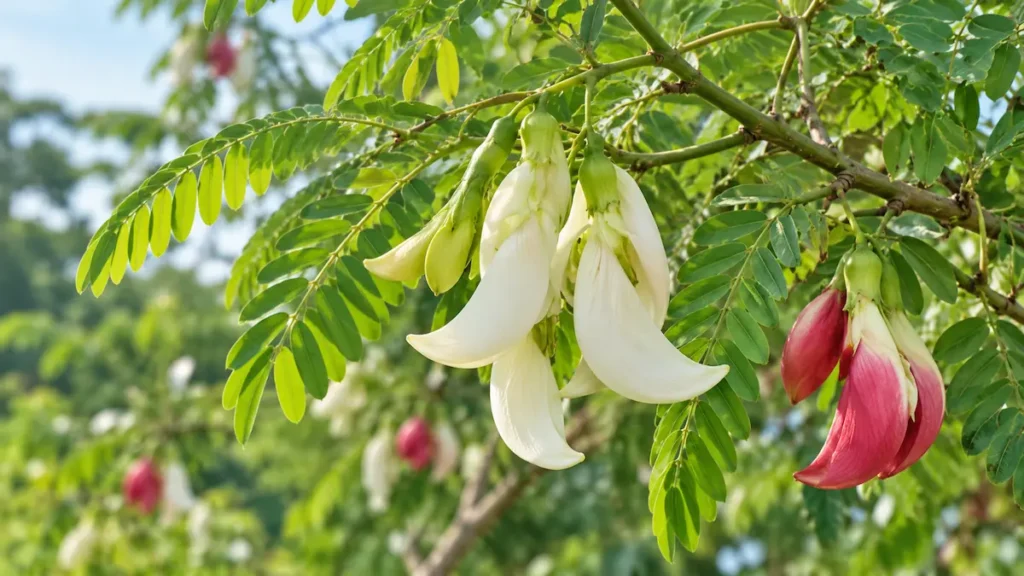
Agastya Benefits are commonly discussed in traditional Indian medicine. Agastya, also known as Sesbania grandiflora, is a well-known plant that belongs to the Fabaceae family and is commonly found in different parts of India.
In different regions, Agastya is known by names such as Agasti, Agathi, Agati, Avisa and Bak.
An official publication from the AYUSH Division, Employees’ State Insurance Corporation (ESIC), New Delhi, mentions several traditional uses of Agastya. Different parts of the plant, including its leaves, flowers, bark and roots, have traditionally been used for problems such as intestinal worms, headache, fever, night blindness, abdominal colic and joint pain.
It is important to understand that these are traditional uses. They should not be considered proven treatments unless supported by strong clinical research.
Key Takeaways
- Agastya is traditionally used for worms, headache, fever, colic and joint discomfort.
- It contains plant compounds with possible antioxidant and anti-inflammatory effects.
- Most medicinal uses still need stronger human clinical evidence.
1. Agastya for Worm Infestation
Agastya leaves have traditionally been used for intestinal worms.
The ESIC AYUSH publication mentions the use of Agastya leaf juice in traditional practice for worm infestation.
This type of traditional use has also been mentioned in herbal medicine literature. However, there is not enough strong human research to prove that Agastya can safely remove intestinal worms on its own.
People with suspected worm infection should get proper diagnosis and treatment, especially children.
2. Agastya for Headache and Sinus Problems
Agastya leaves have also been traditionally used for headache and sinus-related problems.
Traditional Ayurvedic practice includes the use of leaf juice for nasal and sinus complaints. The ESIC source also mentions its use for headache and sinusitis.
However, putting homemade plant juice directly into the nose may not always be safe. Fresh plant preparations may contain germs or substances that can irritate the nose.
Anyone with frequent headaches, sinus pain or long-lasting nasal symptoms should seek medical advice.
3. Agastya for Fever
Agastya leaves are traditionally used during fever.
According to the ESIC AYUSH material, a paste made from the leaves has been applied externally on the body in traditional practice.
This use is part of traditional medicine, but there is not enough clinical evidence to prove that Agastya leaf paste can treat the actual cause of fever.
Fever can be caused by infections and many other conditions. A high, persistent or worsening fever should always be properly checked.
4. Agastya for Night Blindness
One of the most interesting traditional uses of Agastya is for night blindness.
The ESIC source mentions a traditional preparation made using Agastya flowers processed with ghee.
Agastya is also nutritionally interesting because its leaves contain carotenoids. Some carotenoids help the body produce vitamin A, which is important for normal vision.
This may explain why the plant has traditionally been connected with eye health.
However, Agastya should not be considered a proven treatment for night blindness. Difficulty seeing in low light may happen due to vitamin A deficiency or other eye conditions.
Anyone with night vision problems should get proper eye evaluation.
5. Agastya for Colic and Abdominal Pain
Agastya bark has traditionally been used for abdominal discomfort and colic.
The ESIC AYUSH publication describes a bark-based preparation used in traditional practice for abdominal colic.
Agastya has a long history of use for digestive complaints, but there is not enough human research to confirm its effectiveness or safe medicinal dose.
Abdominal pain should not always be treated at home because it may have many causes.
Severe, repeated or unexplained abdominal pain needs medical attention.
6. Agastya for Arthritis and Gout
Agastya root and bark have traditionally been used externally for joint pain and swelling.
The ESIC source mentions the application of root and bark paste for pain and inflammation linked with arthritis and gout.
Modern research has also studied the anti-inflammatory properties of Sesbania grandiflora. Some laboratory and animal studies suggest that the plant contains compounds that may have anti-inflammatory activity.
However, this does not mean Agastya is a proven treatment for arthritis or gout in humans.
People with long-term joint pain, swelling, stiffness or repeated gout attacks should follow proper medical treatment.
What Does Modern Research Say About Agastya Benefits?
Agastya contains several natural plant compounds such as flavonoids, phenolic compounds and other phytochemicals.
Researchers have studied the plant for possible antioxidant, anti-inflammatory and antimicrobial effects.
These findings are promising, but much of the research is still based on laboratory or animal studies.
More high-quality human studies are needed before Agastya can be recommended as a treatment for specific diseases.
Is Agastya Safe?
Agastya leaves and flowers are eaten as food in some parts of India.
However, using a plant as food is different from using concentrated leaf juice, bark powder, root paste or herbal decoctions as medicine.
There is no single scientifically confirmed medicinal dose for Agastya that is suitable for everyone.
Pregnant women, breastfeeding women, children, older adults, people with chronic diseases and anyone taking regular medicines should be careful with herbal remedies and seek professional advice before using them medicinally.
The Bottom Line
Agastya, or Sesbania grandiflora, is an important plant in traditional Indian medicine.
An official ESIC AYUSH publication records its traditional use for worm infestation, headache, sinus problems, fever, night blindness, abdominal colic, arthritis and gout.
Modern research into Agastya Benefits also shows that the plant contains several natural compounds and may have antioxidant and anti-inflammatory properties.
However, most of its traditional medicinal uses still need stronger human clinical evidence.
Agastya is best understood as a traditional medicinal and edible plant with promising scientific interest, rather than as a proven cure for any disease.
References
- AYUSH Division, Headquarters, Employees’ State Insurance Corporation (ESIC), New Delhi. Ayurveda Offering Herbal Healing – Agastya (Sesbania grandiflora).
https://esic.gov.in/attachments/publicationfile/7d11b02e5abb4717d53b4ce05efabd21.pdf - Lakshminarayana R, et al. Determination of major carotenoids in a few Indian leafy vegetables by high-performance liquid chromatography. Journal of Agricultural and Food Chemistry. 2005.
https://pubmed.ncbi.nlm.nih.gov/15826027/ - Arthanari S, Periyasamy P. Phenolic composition, antioxidant and anti-fibrotic effects of Sesbania grandiflora L. (Agastya) – An edible medicinal plant. AYU.
https://pubmed.ncbi.nlm.nih.gov/35813364/ - Distribution, Phytochemical Insights, and Cytotoxic Potential of the Sesbania Genus: A Comprehensive Review.
https://pubmed.ncbi.nlm.nih.gov/39861127/

Medical Disclaimer
This content is for informational purposes only and should not be considered medical advice.