7 Surprising Reasons Mosquitoes Bite You More
Mosquitoes Bite some people more than others, and you may have noticed this yourself. Have you ever wondered why mosquitoes seem to target you while the people around you remain almost untouched? You may be sitting outdoors with family or friends, yet you end up scratching multiple itchy bites while others barely get one.
Many people believe this happens because they have “sweet blood.” Although this idea is very popular, scientific research does not support it. Mosquitoes do not choose people based on how sweet their blood is.
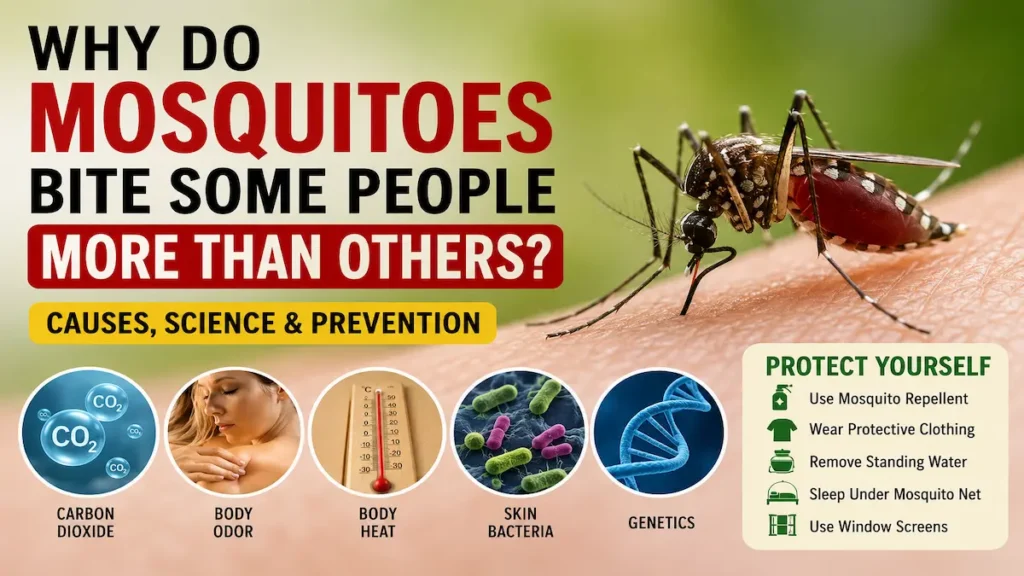
Instead, researchers have found that mosquitoes are attracted by a combination of natural body signals. These include the carbon dioxide you breathe out, your body temperature, your skin’s natural scent, and even certain bacteria that live on your skin. Some of these factors are influenced by genetics, which means some people naturally attract more mosquitoes than others.
Understanding why mosquitoes prefer certain people can help you take better steps to reduce bites and lower the risk of mosquito-borne diseases such as dengue, malaria, chikungunya, Zika virus, and West Nile virus.
In this article, we’ll explore the science behind mosquito attraction, separate myths from facts, and share practical tips to help protect yourself.
How Do Mosquitoes Find Humans?
Only female mosquitoes bite humans because they need protein from blood to produce healthy eggs. Male mosquitoes feed mainly on nectar and plant juices.
Female mosquitoes have highly developed sensory organs that help them detect a nearby person from several meters away. Rather than relying on a single signal, they combine multiple clues to locate their target.
These include:
- Carbon dioxide released when you breathe
- Body heat
- Skin odor
- Sweat and moisture
- Chemical compounds naturally produced by your skin
Once a mosquito detects these signals, it flies closer until it can identify the best place to bite.
1. Carbon Dioxide Is One of the Strongest Signals
Every time you breathe, your body releases carbon dioxide (CO₂) into the air. Female mosquitoes use this gas as one of the first signs that a potential host is nearby.
People who naturally produce more carbon dioxide often attract more mosquitoes. This includes:
- Adults compared with young children
- Taller individuals
- People with larger body size
- Those who have a higher metabolic rate
Carbon dioxide doesn’t tell mosquitoes exactly who to bite, but it helps them locate people from a distance before they rely on other signals like body odor.
This is also why many mosquito traps use carbon dioxide to attract mosquitoes.
2. Your Natural Body Odor Matters More Than You Think
One of the biggest reasons some people attract more mosquitoes is their unique body odor.
Every person’s skin produces a different mix of natural chemicals. These chemicals combine with the harmless bacteria that live on the skin, creating a scent that is unique to each individual.
Mosquitoes are surprisingly sensitive to these natural smells.
Research suggests that some skin chemicals may attract mosquitoes more than others. People whose skin produces higher levels of certain compounds may receive more bites, while others naturally produce scents that mosquitoes find less attractive.
This also explains why two people sitting side by side can experience completely different numbers of mosquito bites.
Your natural body odor is largely determined by genetics, making it difficult to change completely.
3. Body Heat Can Make You More Attractive to Mosquitoes
Mosquitoes are also attracted to warmth.
When your body temperature rises, mosquitoes may find it easier to locate you.
Several situations can increase body heat, including:
- Exercising
- Running
- Walking long distances
- Hot and humid weather
- Pregnancy
For example, people often notice more mosquito bites after outdoor workouts because exercise increases body temperature, breathing rate, and sweating—all of which can attract mosquitoes.
Pregnant women may also receive more mosquito bites because pregnancy naturally increases metabolism and carbon dioxide production.
Does Sweat Attract Mosquitoes?
Sweat itself is not the main reason mosquitoes bite, but it does play a role.
Fresh sweat has very little odor. However, when sweat mixes with bacteria already living on your skin, it creates chemical compounds that mosquitoes can detect.
People who sweat heavily after exercise or outdoor activities may become easier for mosquitoes to locate, especially in warm weather.
That’s one reason why changing sweaty clothes and taking a shower after exercise may help reduce mosquito attraction.
Are Some People Naturally More Attractive to Mosquitoes?
Yes. Scientific research suggests that some people naturally attract more mosquitoes than others.
This doesn’t mean there is anything wrong with their health. Instead, their body chemistry simply produces signals that mosquitoes can detect more easily.
These natural differences may include:
- The amount of carbon dioxide released
- Individual body odor
- Skin bacteria
- Body temperature
- Genetic factors
Because many of these characteristics are inherited, two healthy people living in the same environment may still experience very different numbers of mosquito bites.
Is “Sweet Blood” Really the Reason?
One of the most common myths is that mosquitoes prefer people with “sweet blood” and that this is why mosquitoes bite certain individuals more often.
There is no strong scientific evidence to support this claim. Mosquitoes do not measure how sweet your blood is before biting. Instead, they respond to body odor, carbon dioxide, body heat, and other natural chemical signals.
So, if it seems like mosquitoes bite you more than others, it is much more likely to be because of your body’s natural scent and other biological factors rather than the sugar level in your blood.
Why Do Mosquito Bites Affect People Differently?
Have you ever noticed that two people can be bitten by the same type of mosquito, yet their skin reacts very differently? One person may develop a large, itchy bump, while another only gets a tiny red mark—or no visible reaction at all.
This happens because everyone’s immune system responds differently to mosquito saliva.
When a mosquito bites, it injects a small amount of saliva into the skin. This saliva contains proteins that help the mosquito feed without the blood clotting too quickly. Your immune system recognizes these proteins as foreign substances and reacts by releasing histamine, a chemical that causes itching, redness, and swelling.
Some people produce a stronger immune response, which leads to larger, itchier bumps. Others have a milder reaction and may barely notice the bite.
Children who are bitten for the first time may also react differently because their immune system is still becoming familiar with mosquito saliva.
Does Your Blood Type Matter?
Scientists have studied whether blood type affects mosquito attraction, but the results are mixed.
Some research suggests that people with blood group O may receive more mosquito bites than those with other blood groups. However, other studies have found only small differences or inconsistent results.
At present, experts believe that body odor, carbon dioxide, and body heat are much stronger factors than blood type.
So, even if your blood group plays a small role, it is unlikely to be the main reason mosquitoes choose you.
Who Is More Likely to Get Mosquito Bites?
Although mosquitoes can bite anyone, certain people may naturally attract them more often.
These include:
- Adults compared with young children
- Pregnant women
- People who exercise outdoors
- Individuals with higher body temperature
- People who naturally produce more carbon dioxide
- Those whose skin chemistry is more attractive to mosquitoes
Having one or more of these factors does not guarantee that mosquitoes will bite you, but it may increase the chances.
Myth vs Fact
| Myth | Fact |
| Mosquitoes bite because your blood is sweet. | There is no scientific evidence to support this claim. |
| Only dirty people attract mosquitoes. | Personal hygiene alone does not determine mosquito attraction. |
| Mosquitoes only bite at night. | Different mosquito species bite at different times of the day. |
| Everyone attracts mosquitoes equally. | Body odor, body heat, carbon dioxide, and genetics can make some people more attractive. |
| Only children get mosquito bites. | Mosquitoes bite people of all ages. |
How to Reduce Mosquito Bites
While you cannot completely change your body chemistry, you can lower your chances of being bitten.
Wear Protective Clothing
Choose long-sleeved shirts, full-length pants, and socks when spending time outdoors, especially during mosquito season.
Use an EPA-Registered Mosquito Repellent
Apply a mosquito repellent according to the product instructions. Repellents can provide effective protection when used correctly.
Remove Standing Water
Mosquitoes lay their eggs in standing water. Empty buckets, flower pots, bird baths, old tires, and other containers that collect water around your home.
Install Window and Door Screens
Good-quality screens help prevent mosquitoes from entering your home.
Sleep Under a Mosquito Net
If mosquitoes are common in your area, especially while traveling, sleeping under an insecticide-treated mosquito net can provide additional protection.
Avoid Outdoor Activity During Peak Mosquito Hours
Some mosquito species are more active around sunrise and sunset. Limiting outdoor exposure during these times may help reduce bites.
Expert Advice
According to public health experts, mosquitoes are mainly attracted by body odor, carbon dioxide, body heat, and certain natural chemicals on the skin—not by “sweet blood.” While some people naturally attract more mosquitoes than others, everyone should take steps to prevent mosquito bites, particularly in areas where mosquito-borne diseases are common.
Key Facts
- Female mosquitoes bite humans to obtain protein needed for egg production.
- Carbon dioxide is one of the first signals mosquitoes use to locate people.
- Your natural body odor plays a major role in mosquito attraction.
- Exercise and higher body temperature may increase mosquito activity around you.
- “Sweet blood” is a common myth and is not supported by scientific evidence.
- Using repellents and removing standing water can help reduce mosquito bites.
Conclusion
If you’ve ever wondered why mosquitoes bite some people more, the answer lies in science rather than myths. Mosquitoes are attracted by a combination of carbon dioxide, body heat, natural skin odor, and individual body chemistry. These factors vary from person to person, which explains why some individuals receive more mosquito bites than others.
Although you cannot completely change your natural scent or genetics, simple preventive measures—such as using mosquito repellent, wearing protective clothing, and removing standing water—can significantly reduce your risk of mosquito bites.
Understanding how mosquitoes find their hosts is the first step toward protecting yourself and your family from both itchy bites and mosquito-borne diseases.
Frequently Asked Questions (FAQs)
1. Why do mosquitoes bite some people more than others?
Mosquitoes are mainly attracted by body odor, carbon dioxide, body heat, and certain skin chemicals. These factors vary from person to person.
2. Is it true that mosquitoes like sweet blood?
No. There is no strong scientific evidence that mosquitoes prefer people because their blood is “sweet.”
3. Does blood type affect mosquito bites?
Some studies suggest blood group O may attract more mosquitoes, but the evidence is not conclusive. Body odor and carbon dioxide appear to play a much larger role.
4. Why do mosquito bites itch?
Mosquito bites itch because your immune system reacts to proteins in mosquito saliva by releasing histamine.
5. How can I prevent mosquito bites naturally?
Wearing protective clothing, using mosquito repellents, removing standing water, installing window screens, and sleeping under mosquito nets can all help reduce mosquito bites.
References
- World Health Organization (WHO) – Mosquito-borne diseases
https://www.who.int - Centers for Disease Control and Prevention (CDC) – Prevent Mosquito Bites
https://www.cdc.gov/mosquitoes - National Health Service (NHS) – Insect Bites and Stings
https://www.nhs.uk/conditions/insect-bites-and-stings/ - PubMed – Research on Mosquito Attraction and Human Body Odor
https://pubmed.ncbi.nlm.nih.gov/ - American Mosquito Control Association (AMCA)
https://www.mosquito.org

Medical Disclaimer
This content is for informational purposes only and should not be considered medical advice.