Sleep Deprivation and Memory: New Research Explains the Brain Health Connection
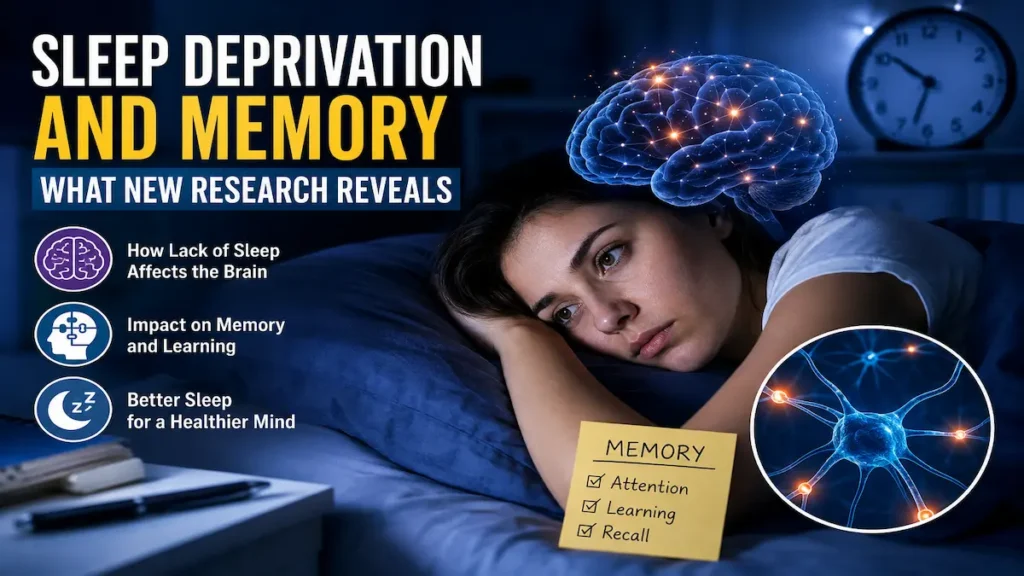
Have you ever walked into a room and forgotten why you went there? Or struggled to remember something you studied the night before after getting very little sleep? Most people have experienced these situations at some point. While occasional forgetfulness is normal, scientists have long been interested in understanding how poor sleep affects the brain and memory.
A recent scientific review published in Brain Sciences examined decades of research on sleep deprivation and memory. The review explored findings from laboratory and human studies to understand how insufficient sleep may influence learning, memory formation, and overall brain function. Although much of the detailed biological evidence comes from animal research, the findings provide valuable insights into why healthy sleep is considered essential for a healthy brain.
Key Takeaways
- Sleep helps the brain process and store memories.
- Healthy sleep supports learning, focus, and brain function.
- Long-term sleep deprivation may affect memory and cognition.
- Most evidence comes from laboratory studies, with more human research needed.
- Getting enough quality sleep may support long-term brain health.
Why Is Sleep So Important?
Many people think sleep is simply a time when the body rests after a busy day. Modern research tells a different story. Even while we are asleep, the brain remains highly active. During sleep, it processes information collected throughout the day, strengthens important memories, removes unnecessary information, and prepares the brain for learning the next day.
This is one reason why experts often recommend getting enough sleep after studying or learning a new skill. Sleep is not “wasted time”—it is an active biological process that supports both physical and mental health.
Researchers believe that when sleep is regularly shortened or interrupted, these important brain processes may not work as efficiently. Over time, this may affect attention, concentration, decision-making, and different types of memory.
What Did the Researchers Study?
Instead of performing a single experiment, scientists reviewed numerous previously published studies related to sleep deprivation and memory. This type of research, known as a scientific review, helps researchers identify common findings across multiple studies rather than relying on one experiment alone.
The review included evidence from neuroscience, sleep medicine, molecular biology, and behavioral science. Researchers looked at how sleep loss may affect different brain regions, memory processes, and biological pathways involved in learning.
Their goal was to answer several important questions:
- How does sleep help the brain form memories?
- What changes occur when people do not get enough sleep?
- Which areas of the brain are involved?
- What do laboratory studies suggest about memory loss?
- Which questions still require more human research?
Understanding How Memory Works
Memory is much more than simply remembering names or dates. Scientists generally describe memory as a three-step process.
The first step is encoding, where the brain receives new information. For example, when you learn a new phone number, attend a lecture, or meet someone for the first time, your brain begins processing that information.
The second step is memory consolidation. During this stage, the brain organizes and strengthens newly learned information so that it can be stored more effectively. Researchers believe sleep plays a major role during this phase.
The final step is retrieval, which is the ability to remember information later when you actually need it. Whether you are answering an exam question, recalling a password, or recognizing a familiar face, retrieval allows stored memories to be accessed.
If sleep is repeatedly disrupted, researchers believe one or more of these stages may become less efficient, making learning and remembering more difficult.
The Hippocampus: The Brain’s Memory Center
One of the most important brain regions discussed in sleep research is the hippocampus. Located deep inside the brain, this small structure plays a key role in forming new memories.
You can think of the hippocampus as a temporary storage system. Whenever you learn something new—whether it is a recipe, a driving route, or a colleague’s name—the hippocampus helps organize that information before it becomes a long-term memory.
Researchers believe healthy sleep allows the hippocampus to communicate effectively with other parts of the brain responsible for long-term memory storage. When sleep is repeatedly reduced, this communication may become less efficient, making it harder for the brain to retain newly learned information. Much of this understanding comes from laboratory studies, and scientists continue to investigate how these mechanisms operate in humans.
What Did the Review Find?
After examining evidence from many studies, researchers observed a consistent pattern: healthy sleep appears to support healthy memory.
The review suggests that insufficient sleep may affect several types of memory, including:
- Working memory, which helps us temporarily hold information while completing a task.
- Short-term memory, used for remembering recent information.
- Long-term memory, where information is stored for longer periods.
- Spatial memory, which helps us remember locations and directions.
- Recognition memory, which allows us to identify familiar people, places, or objects.
Not every study reported identical results, and researchers noted that factors such as age, overall health, study methods, and the duration of sleep deprivation can influence outcomes. However, the overall evidence suggests that regularly getting enough quality sleep supports learning and memory more effectively than consistently sleeping too little.
Why One Sleepless Night Is Usually Not the Whole Story
One important message from the research is that a single late night is unlikely to cause permanent memory problems in healthy adults.
Scientists are more concerned about chronic sleep deprivation—a pattern of repeatedly getting too little sleep over weeks or months.
While most people recover after returning to a healthy sleep routine, making insufficient sleep a long-term habit may gradually affect brain performance. Researchers continue studying exactly how these changes occur and how they differ between individuals.
What Happens Inside the Brain During Sleep Deprivation?
One of the most interesting findings from the scientific review is that sleep deprivation does not simply make us feel tired—it may also affect several biological processes that help the brain learn and store information. While many of these discoveries come from laboratory studies in rodents, they provide important clues about how the brain functions and guide future human research.
Researchers believe that during normal sleep, the brain strengthens communication between nerve cells, a process known as synaptic plasticity. In simple words, this is the brain’s ability to build and reinforce connections whenever we learn something new. These stronger connections help transform short-term information into long-term memories.
When sleep is repeatedly reduced, scientists believe this process may become less efficient. Instead of fully strengthening new memories, the brain may struggle to organize and store them properly. This could explain why people often find it harder to concentrate or remember information after several nights of poor sleep.
The review also discusses several natural brain chemicals and proteins involved in learning and memory. One of these is Brain-Derived Neurotrophic Factor (BDNF), a protein that supports the growth and communication of brain cells. Experimental studies suggest that sleep deprivation may influence BDNF activity, although researchers emphasize that more human studies are needed before firm conclusions can be made.
Another area of interest is oxidative stress, which occurs when unstable molecules called free radicals build up faster than the body’s natural antioxidant defenses can remove them. Researchers suggest that prolonged sleep deprivation may increase oxidative stress in the brain, potentially affecting normal cell function. The review also describes how poor sleep may influence inflammatory pathways, but scientists continue to investigate exactly how these biological changes affect human memory over time.
What Does This Mean in Everyday Life?
Most people occasionally lose sleep because of work deadlines, examinations, travel, family responsibilities, or illness. Missing one night of sleep does not mean permanent damage has occurred. Instead, the review highlights that researchers are more concerned about repeated or long-term sleep deprivation, where people consistently fail to get enough quality sleep.
Students, office workers, healthcare professionals, shift workers, and parents of young children are among the groups most likely to experience ongoing sleep loss. When poor sleep becomes a regular habit, it may affect attention, learning, productivity, and memory, making everyday tasks more challenging. However, these problems can also be influenced by stress, mental health, nutrition, medications, and other medical conditions, so sleep is only one part of the overall picture.
Simple Habits That May Support Better Sleep
Although every person has different sleep needs, health experts generally recommend a few practical habits that may help improve sleep quality.
- Maintain a regular bedtime and wake-up schedule, even on weekends.
- Reduce the use of phones, tablets, and other bright screens before going to bed.
- Limit caffeine late in the day if it affects your sleep.
- Keep your bedroom quiet, dark, and comfortable.
- Stay physically active during the day, as regular exercise supports overall health and may improve sleep for many people.
- Try relaxation techniques such as reading, meditation, or gentle stretching if stress makes it difficult to fall asleep.
These habits are not guaranteed treatments for sleep disorders, but they are widely recommended as part of healthy sleep practices.
Important Limitations of the Research
Understanding the limitations of scientific research is just as important as understanding the findings.
A significant portion of the biological evidence discussed in this review comes from laboratory animal studies. These experiments allow scientists to examine brain tissue and molecular changes that cannot easily be studied in healthy people. However, results observed in animals cannot automatically be applied to humans.
Researchers also point out that memory is influenced by many factors, including age, emotional well-being, physical health, medications, and lifestyle. Because of these variables, more high-quality human studies are still needed to fully understand how different types of sleep deprivation affect memory over time.
Final Thoughts
The growing body of scientific evidence suggests that healthy sleep plays an important role in supporting learning, memory, and overall brain function. During sleep, the brain appears to organize new information, strengthen important neural connections, and prepare itself for the challenges of the next day.
Although researchers are still exploring the exact biological mechanisms, one message remains consistent: making sleep a priority is an investment in long-term brain health. At the same time, it is important to interpret research carefully. The current evidence does not suggest that one sleepless night will permanently damage memory, nor does it mean that every memory problem is caused by poor sleep. Rather, chronic sleep deprivation may gradually interfere with the brain processes involved in learning and remembering.
If you regularly experience poor sleep, excessive daytime tiredness, or persistent memory difficulties, consider speaking with a qualified healthcare professional. Early evaluation can help identify possible underlying causes and appropriate treatment options.
References
- PMC (Scientific Reports). Sleep Deprivation Impairs Cognitive Performance.
https://pmc.ncbi.nlm.nih.gov/articles/PMC8893218/ - News-Medical. Poor Sleep Alters Brain Communication Networks.
https://www.news-medical.net/news/20260714/Poor-sleep-alters-brain-communication-networks-differently-across-adult-lifespan.aspx - WebMD. Effects of Sleep Deprivation on Memory.
https://www.webmd.com/sleep-disorders/sleep-deprivation-effects-on-memory - Wikipedia. Sleep Deprivation.
https://en.wikipedia.org/wiki/Sleep_deprivation_

Medical Disclaimer
This content is for informational purposes only and should not be considered medical advice.